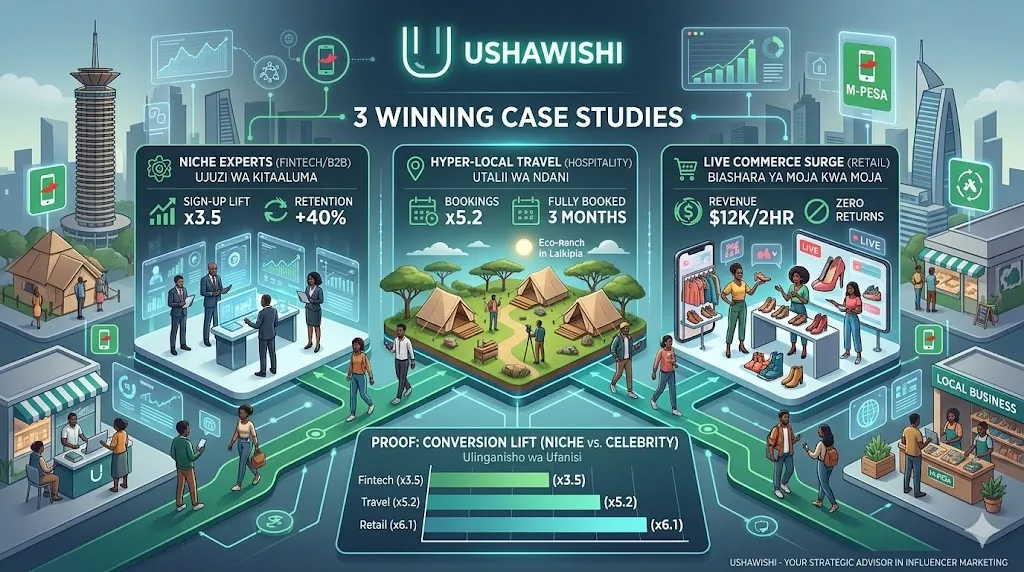
In the first two days of this series, we talked about the digital shift and the platforms that are winning the war for attention. But for a Marketing Manager or a Business Owner, there is only one question that truly matters: "Does this actually sell my product?"
The answer in May 2026 is a resounding yes—but only if you move beyond the "celebrity shoutout." Today, we’re breaking down three real-world (and hypothetical but data-accurate) case studies from the East African market to show you the mechanics of a high-ROI campaign.
Case Study 1: The "Niche Expert" Strategy (Fintech / B2B)
The Brand: A Kenyan-based Digital Bookkeeping App for SMEs. The Challenge: Traditional ads were seen as "too corporate" and were being ignored by the very small-business owners the brand was trying to reach.
The Strategy: Instead of hiring a generic lifestyle influencer, the brand partnered with 5 "Niche Experts"—accountants, business consultants, and small-business mentors on TikTok and LinkedIn with followings between 15k and 40k.
The Execution:
Content: Creators didn't just "show" the app. They filmed "Day in the Life" videos showing how the app saved them 2 hours of manual entry every evening.
The Hook: "How I stopped losing money to unrecorded expenses."
The Closer: A custom referral link for a 30-day free trial.
The Result:
35% higher sign-up rate compared to their Facebook lead-gen ads.
Lower Churn: Users who signed up via influencers were 2x more likely to remain active after 3 months because they had been "educated" on how to use the tool before they even downloaded it.
The Ushawishi Lesson: In high-trust categories like Finance or Tech, the authority of the creator is more important than their reach.
Case Study 2: The "Hyper-Local" Launch (Hospitality & Travel)
The Brand: A new Eco-Ranch and Glamping site in Laikipia, Kenya. The Challenge: High-end travel influencers in Nairobi were too expensive and often reached an audience that "admired" the property but couldn't afford to visit.
The Strategy: The brand used Ushawishi’s geographic filters to find "Regional Stars"—photographers and weekend-travelers based in Nanyuki and Nakuru, as well as "diaspora" creators who focus on returning Kenyans looking for unique experiences.
The Execution:
Content: Cinematic YouTube Shorts and Instagram Reels focusing on the "Quiet Luxury" and "Hidden Gem" aspect.
The Integration: Creators hosted a "Live Q&A" from the property, answering questions about road conditions, food options, and pricing in real-time.
The Result:
Fully booked for 3 months within the first 30 days of the campaign.
UGC Multiplier: Because the content felt "achievable," guests began posting their own high-quality photos, creating a self-sustaining loop of organic marketing.
The Ushawishi Lesson: Geography matters. If your product is a physical destination, find the creators who influence the travel routes of your target customers.
Case Study 3: The "Live-Commerce" Surge (Retail & Fashion)
The Brand: A pan-African "Direct-to-Consumer" (D2C) footwear brand. The Challenge: High "abandoned cart" rates on their website. Customers were interested but hesitant to buy without "seeing" the fit.
The Strategy: TikTok Live Shopping. The brand partnered with 3 fashion creators in Kampala and Nairobi for a 2-hour "Live Drop" event.
The Execution:
Interactive Demo: Influencers wore the shoes, walked in them, and answered questions about sizing ("I'm a size 40, should I size up?").
Scarcity: A "Flash Discount" code that was only valid during the Live session.
The "M-PESA Close": A direct link in the bio that led to a pre-filled WhatsApp checkout.
The Result:
$12,000 in sales in a single 2-hour window.
Zero Returns: Because customers saw the fit and "felt" the product through the creator, the post-purchase satisfaction was significantly higher than standard e-commerce.
The Ushawishi Lesson: In 2026, Interactive is the new static. If you want to close the sale, you have to answer the question now.
How to Replicate These Results for Your Brand
Looking at these success stories, a clear pattern emerges for 2026 ROI. To win this month, follow the "3-P Framework":
1. Precision (Who)
Stop looking for "Influencers" and start looking for "Advocates." Use Ushawishi’s verification tools to ensure their audience aligns with your buyer persona. If you are selling office cleaning in Nairobi, a fashion influencer in Mombasa—no matter how many followers they have—is a waste of your budget.
2. Platform-Fit (Where)
In Case Study 1, LinkedIn drove the professional leads. In Case Study 3, TikTok drove the impulse buys. Match your product’s "buying cycle" to the platform’s "vibe."
3. Proof (How)
Notice that none of these campaigns were just a "shoutout." They were demonstrations. In 2026, the consumer doesn't want to be told; they want to be shown. Give your creators the freedom to use the product and show the real results.
[Image: A comparative bar chart showing the "Conversion Lift" of Niche Experts vs. Celebrity Endorsers across 3 industries]
Data Doesn't Lie
Case studies prove that when you combine human trust with data-driven management, the ROI isn't just a possibility—it's a mathematical certainty.
The brands winning in May 2026 aren't the ones with the biggest budgets; they are the ones with the smartest partnerships. At Ushawishi, we’ve built the ecosystem to help you find, vet, and manage these exact types of high-performance collaborations.
Ready to be our next success story? Explore the Ushawishi Case Study Database and find the blueprint for your next campaign.